

Short answer
Sit quietly for 5 minutes with your back supported, feet flat and your arm resting at heart level, with the cuff on bare skin. Skip caffeine, exercise, smoking and food for 30 minutes first, empty your bladder, don't talk, and take 2 readings 1–2 minutes apart. Small slips like a full bladder or talking can each add around 10 mmHg.
Start with the right monitor and cuff
Guidelines prefer an automatic monitor with an upper-arm cuff that has been checked for accuracy. If you're not sure about yours, take it to your next appointment or ask a pharmacist to compare it with their reading. Our guide on how to check if your blood pressure monitor is accurate walks through the AMA's comparison test.
Cuff size matters more than most people think. A cuff that's too small for your arm can add 2–10 mmHg. Most cuffs print a size range on the inside, so measure around the middle of your upper arm and check you're within it. Our cuff size chart shows each size and how to measure your arm.
The 30 minutes before you measure
A lot of what skews a reading happens before the cuff goes on. The CDC's advice for the half hour before a reading:
- Don't eat or drink.
- Avoid caffeine, alcohol and smoking.
- Don't exercise. Even a brisk walk up the stairs can lift the next reading.
- Empty your bladder. A full bladder can add about 10 mmHg.
If you've just come in from outside or rushed to sit down, give yourself extra time. The point is to measure your body at rest, not your body recovering from something. For how long effects like caffeine or a cigarette last past the 30 minutes, see how long to wait before taking your blood pressure.
How to sit (and what each mistake costs)
Posture errors are small on their own, but they stack. These estimates come from the US Million Hearts list of common measurement errors:
- Back unsupported or feet dangling: adds about 6 mmHg. Use a chair with a back and keep both feet flat on the floor.
- Legs crossed: adds 2–8 mmHg.
- Arm hanging or held up: adds about 10 mmHg. Rest it on a table so the cuff sits at roughly heart level.
- Cuff over clothing: adds 5–50 mmHg. Roll your sleeve up fully, or take your arm out of it, so the cuff sits on bare skin.
Once you're in position, sit quietly for at least 5 minutes before you press start.
During the reading
Don't talk, and don't listen closely to a conversation either. Talking or active listening can add about 10 mmHg. Put your phone down and stay still until the cuff fully deflates.
Then take a second reading 1–2 minutes later. Write down both, or the average, rather than picking the one you like. Two readings smooth out some of the normal moment-to-moment wobble.
If your monitor shows a heart icon or IHB next to a reading, see what the irregular heartbeat symbol means before reading anything into the number.
Which arm to use
The two arms don't always read the same. NICE asks for blood pressure to be measured in both arms. If the difference is more than 15 mmHg, repeat the measurements; if it's still more than 15 mmHg, use the arm with the higher reading from then on.
The difference matters for more than accuracy. A 2012 Lancet analysis (Clark and colleagues) found a gap of 15 mmHg or more between arms was linked to peripheral vascular disease and a higher risk of death from cardiovascular causes.
The American Heart Association's patient page says you can use either arm, so guidance differs. A practical middle ground: ask your doctor to compare both arms at your next appointment, then use the same arm at home each time and note which one in your log.
Best time of day to measure, and how often
For day-to-day tracking, the CDC suggests measuring at the same time each day, so readings are comparable. Morning and evening is a common pattern.
When home readings are used to confirm a diagnosis, NICE (the UK's guideline body) asks for a more structured week:
- 2 readings at least 1 minute apart, seated, each time you measure.
- Measure twice a day, ideally morning and evening.
- Keep going for at least 4 days, ideally 7.
- Ignore the first day's readings and average the rest.
Our home blood pressure average calculator works out that NICE-style average for you.
Outside a diagnosis week there's no single schedule. The 2017 ACC/AHA home monitoring procedure suggests measuring daily in the week before a clinic visit, and the CDC suggests measuring at the same time each day and asking your care team how often. Many people find morning readings run higher; our guide on why blood pressure is higher in the morning explains why.
NICE and the NHS treat a home average of 135/85 or higher as high. US guidelines use 130/80 as the start of Stage 1. Ask your doctor which target applies to you. If your home numbers are consistently lower than your clinic numbers, our page on white coat syndrome explains why that happens.
Using your 5 minutes of rest
Guidelines don't say how to spend the 5 quiet minutes, only that you should sit still and not talk. Some people find that harder than it sounds and end up scrolling their phone or thinking about work.
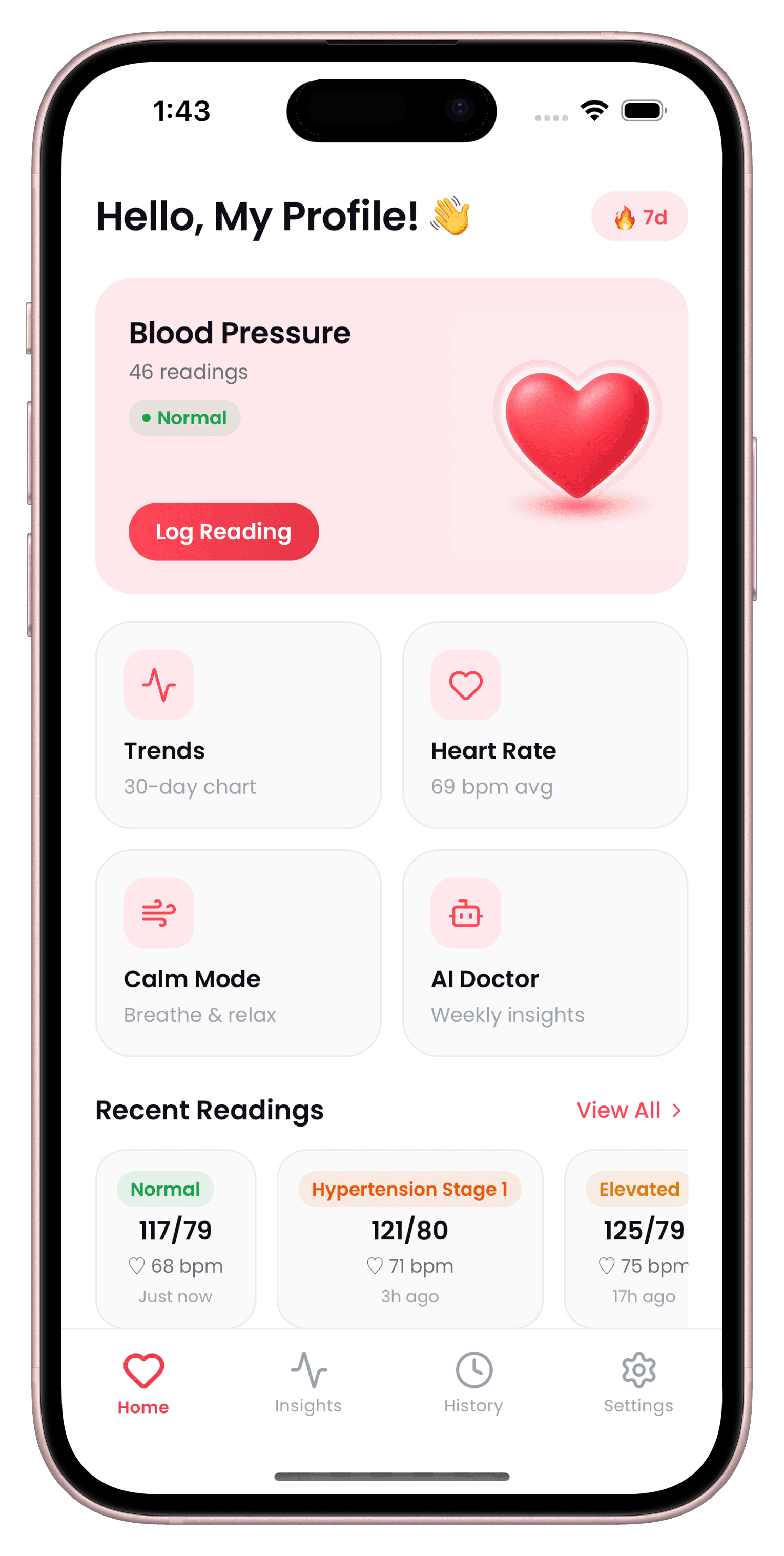
CardiLog's Calm Mode is one structured way to use that time. It guides you through a short breathing pattern (Calm 4-4-6, 4-7-8, Box 4-4-4 or Coherent 5-0-5), 4 rounds each, which takes a minute or two. Then keep sitting quietly for the rest of your 5 minutes.
It isn't a trick for getting a lower number. The aim of the rest period is a reading that reflects your normal resting state, and readings taken after Calm Mode can be flagged "Calm Mode used" so you can tell them apart in your history. If you only ever measure after breathing exercises, mention that to your doctor.
Log all your readings, with context
A careful measurement is only useful if you keep it. Write down the date, time, both numbers and your pulse straight away, plus anything unusual: a bad night's sleep, a missed dose, a stressful morning. Our guide to blood pressure logs covers what a good log needs.
In CardiLog you can type a reading in, scan your monitor's display with the camera, or import readings from Apple Health. Context tags (After Exercise, After Meal, Stressed, Relaxed, Medication Taken, Poor Sleep, Caffeine, Alcohol) and location tags (Home, Clinic, Pharmacy, Travel) record the circumstances, and you can set one daily reminder at the time you normally measure.
If a reading is 180/120 or higher and you have symptoms such as chest pain, shortness of breath, back pain, numbness, weakness, vision changes or difficulty speaking, call emergency services. Without symptoms, rest quietly, measure again and contact your doctor promptly if it's still that high.
Sources
- CDC: Measuring Your Blood Pressure
- Million Hearts (HHS): 7 simple tips to get an accurate blood pressure reading
- NICE NG136: Hypertension in adults, recommendations
- NHS: High blood pressure, diagnosis
- Clark CE et al. Association of a difference in systolic blood pressure between arms with vascular disease and mortality. Lancet 2012
- ACC/AHA 2017 home blood pressure monitoring procedure (Circulation Research 2021, table 2)
- American Heart Association: Monitoring your blood pressure at home
This guide is general information, not medical advice. CardiLog is not a medical device. Talk to your doctor about your own readings.