

Short answer
For most people, it doesn't seem to matter whether blood pressure pills are taken in the morning or at night. The TIME trial (21,104 UK adults, Lancet 2022) and the BedMed trial (3,357 Canadian adults, JAMA 2025) found no difference in heart attacks, strokes or deaths. Take them at a consistent time you'll remember, and talk to your doctor before switching.
The short version
- One large Spanish trial (Hygia, 2019) reported far fewer heart attacks and strokes with bedtime dosing. Its methods were heavily criticized.
- Two large trials designed to test the same question, TIME (UK, 2022) and BedMed (Canada, 2025), found no difference between morning and evening dosing.
- Neither timing caused safety problems in those trials.
- Missing doses matters far more than the hour you take them.
None of this means your doctor's specific instructions are wrong. Some medicines have practical reasons to be taken at a certain time, and that advice still applies.
Why bedtime dosing became popular: the Hygia trial
The Hygia Chronotherapy Trial, published in the European Heart Journal in 2019, followed 19,084 adults with high blood pressure in primary care clinics in Galicia, Spain, for an average of 6.3 years. Half were assigned to take at least one of their blood pressure medicines at bedtime, half to take them all on waking.
The reported result was striking: about 45% fewer cardiovascular events (death from heart disease, heart attack, heart failure, stroke or a procedure to unblock heart arteries) in the bedtime group. Headlines followed, and some patients switched their pills to the evening.
Other researchers raised serious concerns:
- The effect looked implausibly large: about a 45% reduction, when critics expected something closer to 20% even if timing did help.
- Questions were raised about how participants were randomized, given differences between the groups at the start.
- The trial was open-label, so participants and doctors knew who was in which group, and most events counted were non-fatal ones that can be judged subjectively.
- Critics said the paper didn't describe independent checking of endpoints or trial monitoring, and the dropout rate was unusually low for a study that size.
In 2020 the European Heart Journal published an expression of concern about the paper while it reviewed it. According to the DynaMed summary, that review found no grounds for an ethical or factual concern. Even so, many experts still treat the results with caution, because no other large trial has reproduced them.
The TIME trial (2022): no difference
The TIME study was set up in the UK specifically to test whether evening dosing beats morning dosing. It enrolled 21,104 adults taking blood pressure medication and randomly assigned them to take all their usual blood pressure pills in the morning (6–10 am) or the evening (8 pm–midnight). Participants were followed for about 5 years.
Results were published in The Lancet in 2022. The main outcome (death from vascular causes, or hospital admission for a non-fatal heart attack or stroke) happened in 3.4% of the evening group and 3.7% of the morning group. That difference wasn't statistically significant. Falls were slightly less common in the evening group (21.1% vs 22.2%), and there were no new safety concerns.
TIME has limits too. Participants were mostly lower-risk, white, recruited online and had a regular doctor, and some people in each group drifted away from their assigned timing. Still, it's a large, cleanly designed trial, and it didn't find the benefit Hygia reported.
BedMed and BedMed-Frail (2025): the same answer
Two Canadian trials asked the same question in different groups of people.
- BedMed (JAMA, 2025): 3,357 adults in primary care, median age 67, followed for a median of 4.6 years. Death, or hospital care for stroke, acute coronary syndrome (heart attack or unstable angina) or heart failure: 2.3 vs 2.4 per 100 patient-years for bedtime vs morning. No difference in falls, fractures, glaucoma or cognitive decline either.
- BedMed-Frail (JAMA Network Open, 2025): 776 nursing home residents, median age 88. No significant difference in the main outcome. Unplanned hospital visits were lower with bedtime dosing, a secondary finding that needs confirming.
Put together with TIME, that's more than 25,000 people randomized in trials that found timing made no meaningful difference to heart attacks, strokes or deaths.
So when should you take yours?
The evidence points to the time you'll stick with. A pill taken every day at 9 pm does more than one taken at 8 am four days out of seven. Tie it to something you already do daily, like breakfast or brushing your teeth.
There are still good reasons your doctor might suggest a particular time:
- Water pills (diuretics) are often taken in the morning so you're not up at night to use the bathroom.
- If a medicine makes you dizzy or tired, your doctor may suggest taking it in the evening.
- Some people have high blood pressure mainly at night, which a 24-hour monitor can show. Doctors may adjust timing in that case.
Don't change your timing, skip doses or double up on your own. If you're thinking of switching, ask your prescriber or pharmacist first. They know your full list of medicines.
Checking how your routine is working
Home readings are the simplest way to see whether your blood pressure is under control at the times that matter to you. Measuring morning and evening, as described in our guide to accurate home readings, shows whether it's higher at one end of the day.
If your morning readings run higher than your evening ones, our guide on why blood pressure is higher in the morning covers the common causes, including medication wearing off before the next dose.
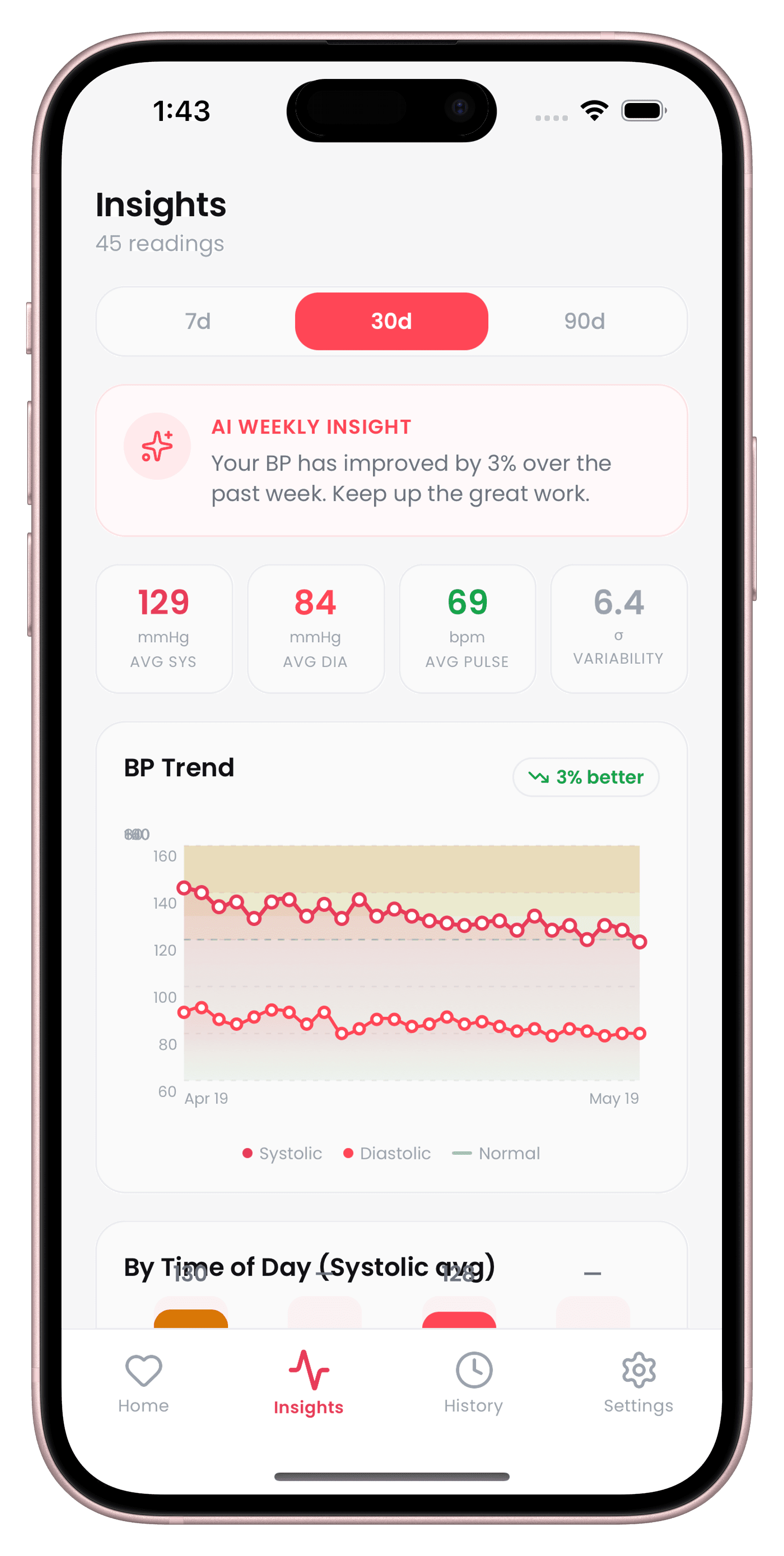
In CardiLog, you can tag a reading with Medication Taken, so over several weeks you can see how readings on days you took your pills compare with days you didn't. CardiLog's weekly insight is built on-device from fixed rules. It flags a Morning Surge when your morning systolic is more than 20 mmHg above the previous night's reading, and a sustained rise if your systolic average has gone up 5+ mmHg over the last two weeks.
CardiLog doesn't have medication reminders or a list of your medicines. You can set one daily reminder to log a reading. Its Medication Check questionnaire is a self-assessment, not medical advice. For more on day-to-day routines, see daily hypertension management. Bring your readings to your doctor, who can decide whether your timing needs to change.
Sources
- ACC: Treatment in Morning versus Evening (TIME) trial summary
- ACC Journal Scan: Timing of Antihypertensives (BedMed and BedMed-Frail)
- DynaMed (EBSCO): The Antihypertensive Dosing Saga
- Wiki Journal Club: Hygia Chronotherapy Trial
This guide is general information, not medical advice. CardiLog is not a medical device. Talk to your doctor about your own readings.