

Short answer
Blood pressure starts climbing in the hours before you wake, so morning readings often run higher than evening ones. That rise is normal. Morning readings that stay at 135/85 or higher at home can point to medication wearing off, sleep apnea or blood pressure that isn't well controlled, so raise them with your doctor.
The normal daily pattern
Blood pressure isn't fixed over the day. Mayo Clinic describes the typical pattern: it starts to rise in the hours before you wake, keeps rising to a peak around midday, falls in the late afternoon and evening, and is at its lowest while you sleep.
So a morning reading somewhat higher than last night's isn't a warning sign by itself. What matters is how high the morning number is, and whether it stays high day after day.
The morning also matters for a second reason. In a study of 2,999 people with heart attacks (Muller and colleagues, 1985), the most common time for symptoms to start was between 6 a.m. and noon. That's one reason researchers have paid close attention to morning blood pressure.
What doctors mean by a morning surge
"Morning surge" has a research definition, and it's narrower than "my morning reading is high":
- Sleep-trough surge: the average systolic over the 2 hours after waking minus the average around the lowest point during sleep. It needs a 24-hour ambulatory monitor, not a home cuff.
- In a 2003 study of older adults with hypertension (Kario and colleagues, Circulation), people in the top tenth of morning surge (55 mmHg or more) had more strokes: 19% versus 7.3% over the study period.
- Most, but not all, later studies found a similar link, and the surge measurement isn't very reproducible from one recording to the next.
For home readings, an expert consensus on morning hypertension (Wang and colleagues, 2018) uses a simpler test: a morning home reading of 135/85 or more. That's the number to watch on your own cuff.
Common reasons for high morning readings
- Medication wearing off: if your pills don't last a full 24 hours, or the dose is too low, the morning reading taken just before the next dose catches the weakest point. The same consensus lists short- or intermediate-acting drugs and underdosing as causes of high morning readings.
- Sleep apnea: obstructive sleep apnea is common in people with high blood pressure (40% to 80%, according to a 2021 American Heart Association statement) and is linked to blood pressure that doesn't fall normally at night.
- How the reading was taken: measuring straight out of bed, with a full bladder, after coffee or a cigarette, or while rushing can all push the number up.
- Blood pressure that's high overall: if your evening readings are also high, the morning number is part of a wider pattern rather than a morning problem.
Only a doctor can tell these apart, and they may suggest a 24-hour ambulatory monitor or a sleep study. A log of morning and evening readings, taken the same way each day, is what makes that conversation useful.
How to take a morning reading
Guidelines agree on the basics for morning readings at home:
- Measure within about an hour of waking, but not the moment you sit up. The 2024 ESC guideline says not immediately after waking.
- Empty your bladder first.
- Measure before you take your blood pressure medication and before breakfast.
- No caffeine, smoking or exercise in the 30 minutes before.
- Sit quietly for 5 minutes, then take 2 readings a minute apart.
Then take an evening reading the same way, so you have something to compare against. Our guide to taking an accurate measurement covers posture and cuff position, and the home blood pressure average calculator turns a week of morning and evening readings into one average.
Should you change when you take your pills?
If morning readings run high, moving your pills to bedtime can sound like an obvious fix. Two large trials tested it. The TIME trial (21,104 UK adults, Lancet 2022) and the BedMed trial (3,357 Canadian adults, JAMA 2025) found no difference in heart attacks, strokes or deaths between morning and evening dosing.
So timing is something to decide with your prescriber, not on your own. Our guide to the best time to take blood pressure medication goes through the evidence.
When to talk to your doctor
- Your morning home readings are regularly 135/85 or higher.
- Your morning readings are consistently much higher than your evening ones.
- Your morning numbers are high even though you're taking your medication as prescribed.
- Your blood pressure is hard to control. The 2021 American Heart Association statement recommends screening for sleep apnea in that situation.
If a reading is 180/120 or higher, wait a minute and measure again. If it's still that high, contact your doctor. If you also have chest pain, shortness of breath, weakness, vision changes or trouble speaking, call emergency services.
How CardiLog flags morning patterns
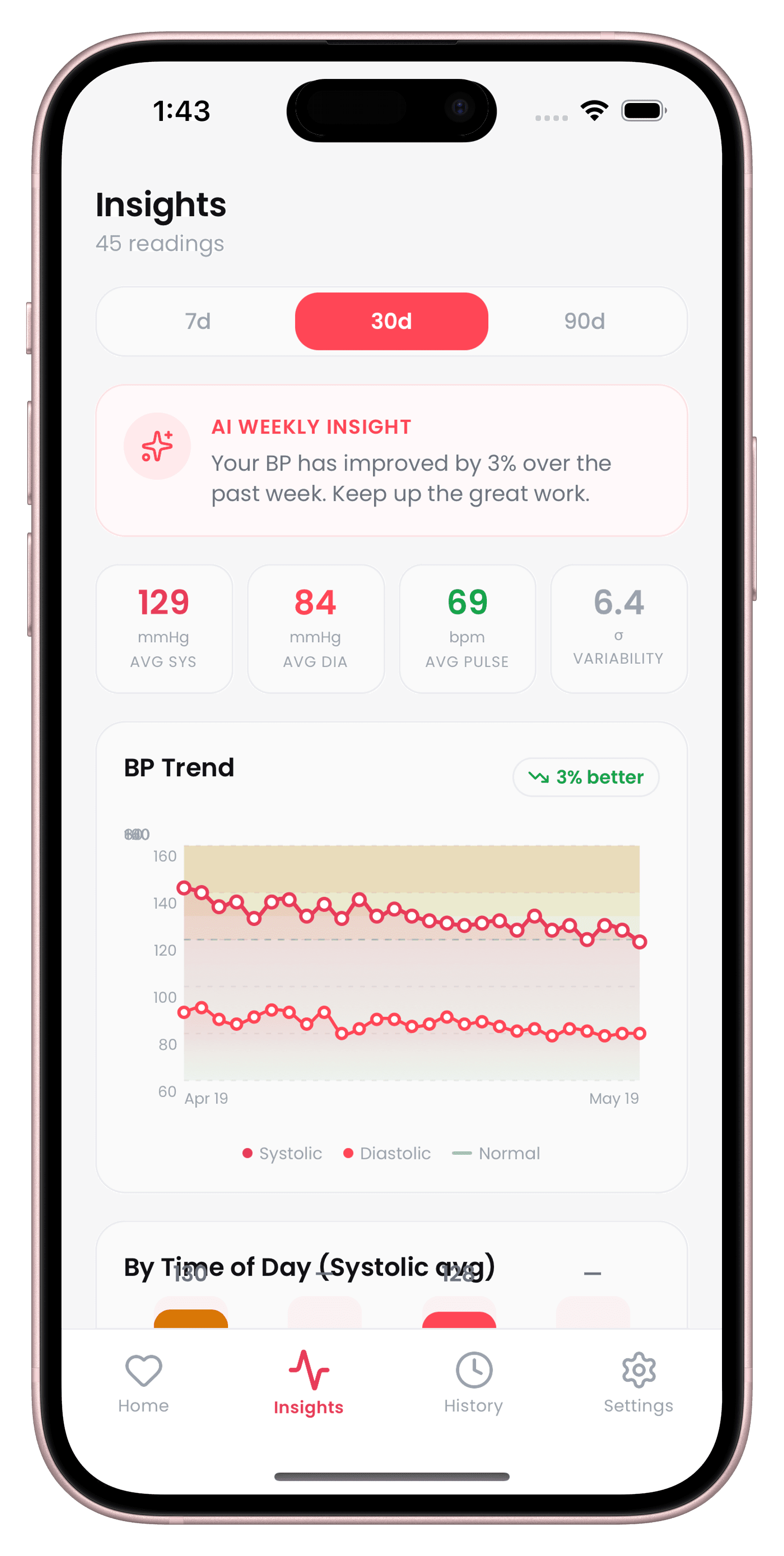
The CardiLog app has a Morning Surge check that runs on your phone: it flags a morning systolic reading more than 20 mmHg above the previous night's. That's the app's own rule for spotting a pattern worth mentioning, not the research definition above, and a flag isn't a diagnosis.
CardiLog also breaks your systolic readings down by time of day (morning, afternoon, evening and night), and you can tag readings with Medication Taken, Poor Sleep, Caffeine or Alcohol so the context is there when you look back. The PDF report gives your doctor the full history.
Sources
- Mayo Clinic: Blood pressure, does it have a daily pattern?
- Kario K et al. Morning surge in blood pressure as a predictor of silent and clinical cerebrovascular disease in elderly hypertensives. Circulation 2003
- Wang JG, Kario K et al. Management of morning hypertension: a consensus statement of an Asian expert panel. J Clin Hypertens 2018
- Muller JE et al. Circadian variation in the frequency of onset of acute myocardial infarction. N Engl J Med 1985
- Yeghiazarians Y et al. Obstructive sleep apnea and cardiovascular disease: AHA scientific statement. Circulation 2021
- Cuspidi C et al. Meta-analysis of obstructive sleep apnea and nocturnal non-dipping blood pressure (2019)
- Mackenzie IS et al. Cardiovascular outcomes in adults with hypertension with evening versus morning dosing (TIME). Lancet 2022
- Garrison SR et al. Bedtime vs morning antihypertensive medication timing (BedMed). JAMA 2025
- McEvoy JW et al. 2024 ESC Guidelines for the management of elevated blood pressure and hypertension. Eur Heart J 2024
- American Heart Association: Monitoring your blood pressure at home
This guide is general information, not medical advice. CardiLog is not a medical device. Talk to your doctor about your own readings.