

Short answer
Take 2 readings a minute apart, morning and evening, for at least 4 days and ideally 7. Leave out the first day, then average the rest, systolic and diastolic separately. NICE and the 2024 ESC guideline both treat a home average of 135/85 or higher as hypertension.
Home blood pressure average calculator
Type each reading as systolic/diastolic, for example 132/84. Leave blanks for readings you didn't take. Everything is worked out on this page; nothing you type is sent anywhere or saved.
Your average will appear here as you type readings.
How to collect the readings
NICE (the UK's guideline body) sets out a specific routine for home monitoring when it's used to confirm high blood pressure:
- Each time you measure, sit down and take 2 readings at least 1 minute apart.
- Measure twice a day, ideally in the morning and the evening.
- Keep going for at least 4 days, ideally 7.
- Leave out the first day's readings and average all the rest.
The 2024 European (ESC) guideline is close but not identical: 2 readings 1–2 minutes apart, morning and evening, for at least 3 days and up to 7, with all readings averaged. It doesn't ask you to leave out the first day. The calculator lets you choose either way.
If your doctor has given you a schedule, use theirs. For the routine itself (how to sit, cuff position, what to avoid beforehand), see our guide to taking an accurate measurement at home.
How the average is worked out
The maths is plain arithmetic, done separately for each number:
- Add up all the systolic (top) readings you're keeping and divide by how many there are.
- Do the same for the diastolic (bottom) readings.
- Write the result as systolic/diastolic, rounded to whole numbers.
A full NICE week gives 28 readings (2 per session, 2 sessions a day, 7 days). With the first day left out, 24 go into the average. Missing the odd session is fine; the average is still taken over the readings you have.
Don't average away a reading that worried you. If any single reading is 180/120 or higher, deal with that reading first (see below).
What the thresholds mean for a home average
Home thresholds sit below clinic ones because readings at home tend to be lower. NICE says home averages correspond to clinic readings 5 mmHg lower. How the main guidelines read a home average:
- NICE: 135/85 to 149/94 is stage 1 hypertension; 150/95 or higher is stage 2.
- ESC 2024: 135/85 or higher is hypertension; 120 to 134 systolic or 70 to 84 diastolic is elevated; under 120/70 is non-elevated.
- ACC/AHA 2017 (US): its table of matching values puts 130/80 at home level with stage 1 (130/80 in clinic), and 135/85 at home level with 140/90 in clinic.
Either number can cross a threshold on its own. A home average of 128/86, for example, is in the NICE stage 1 range because of the diastolic. These labels are how guidelines describe readings; your doctor decides what they mean for you, alongside the rest of your health.
Single high readings still matter
An average is the right tool for a diagnosis, but it can hide one dangerous number. If a reading is 180/120 or higher, wait a minute and measure again. If it's still that high, contact your doctor. If you also have chest pain, shortness of breath, weakness, vision changes or trouble speaking, call emergency services.
The calculator flags any reading at that level as soon as you type it, whatever the average says.
Keeping a running average in CardiLog
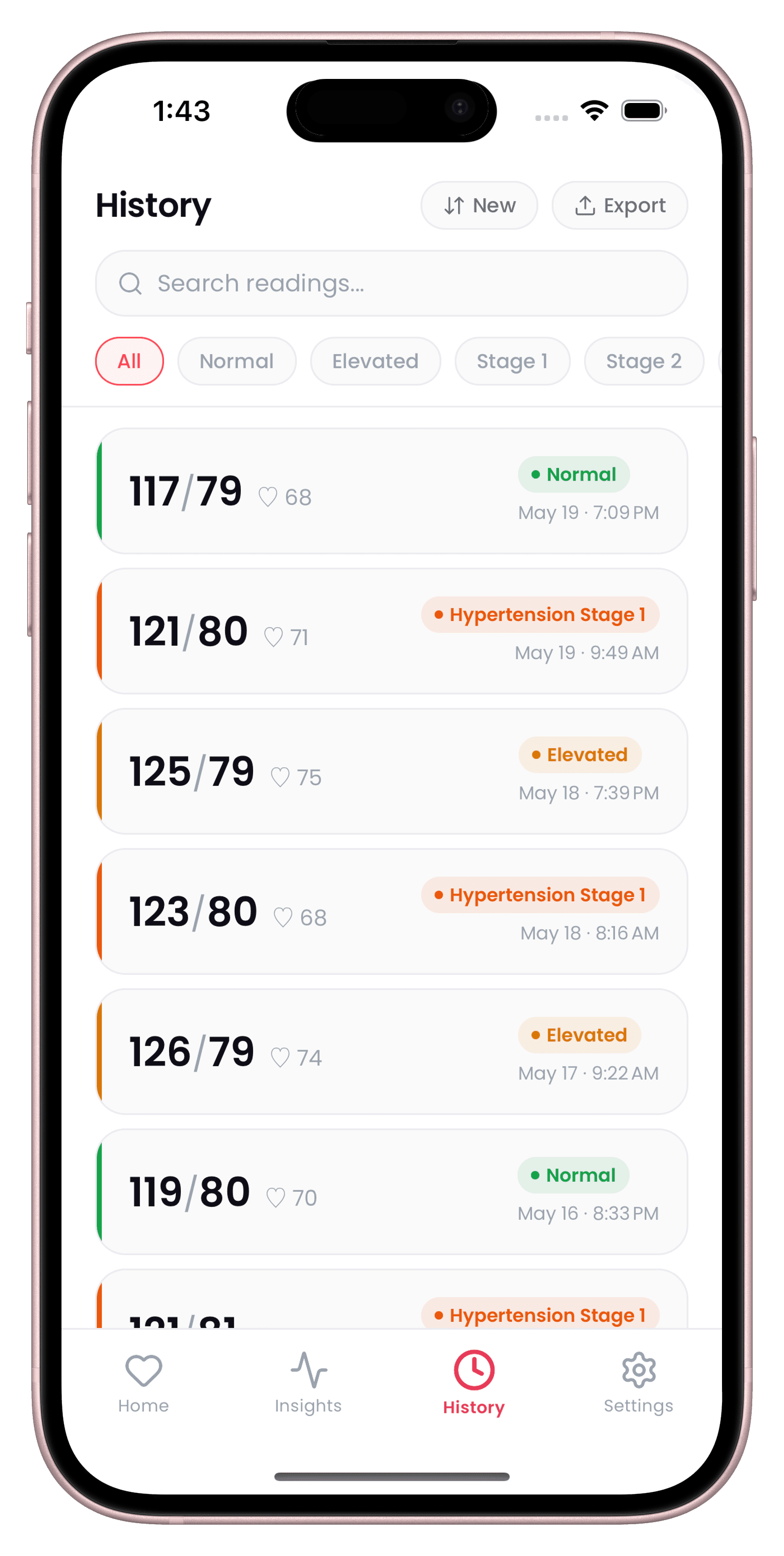
A week of numbers on paper is fine for one diagnosis. If you're tracking for longer, the CardiLog app works out averages for you and charts them over 7, 30 and 90 days, so you can see whether the average is drifting.
Its PDF report includes your readings and averages for your doctor. Tagging each reading Home or Clinic lets CardiLog compare the two: with at least 5 home and 3 clinic readings, it flags a clinic average 10 mmHg or more above your home one, which is the pattern described on our white coat syndrome page.
Sources
- NICE NG136: Hypertension in adults, recommendations (1.2.7) and terms used
- McEvoy JW et al. 2024 ESC Guidelines for the management of elevated blood pressure and hypertension. Eur Heart J 2024;45:3912 (Table 5)
- Corresponding clinic, home and ambulatory values from the 2017 ACC/AHA guideline (Hypertension 2019, table 2)
- American Heart Association: Monitoring your blood pressure at home
- CDC: Measuring Your Blood Pressure
This guide is general information, not medical advice. CardiLog is not a medical device. Talk to your doctor about your own readings.