
Short answer
Guidelines from the American Heart Association, the CDC and the 2024 European guideline agree on a minimum: no caffeine, exercise or smoking for at least 30 minutes before measuring, then sit quietly for at least 5 minutes. The CDC also says not to eat or drink for 30 minutes. Some effects last longer: caffeine can raise blood pressure for 3 hours or more, so measure before your morning coffee if you can.
The minimum the guidelines agree on
The American Heart Association's 2019 statement on blood pressure measurement, the CDC and the 2024 European Society of Cardiology (ESC) guideline give the same core routine:
- No caffeine, exercise or smoking for at least 30 minutes before you measure.
- Don't eat or drink for 30 minutes beforehand (the CDC's wording).
- Empty your bladder first.
- Sit quietly with your back supported for at least 5 minutes, then measure without talking.
Those 30 minutes are a floor, not a promise that every effect is gone. The sections below explain where the research shows a longer effect, and our guide to taking an accurate measurement at home covers posture and cuff position.
After coffee or other caffeine
A 2011 review of studies (Mesas and colleagues, American Journal of Clinical Nutrition) found that 200 to 300 mg of caffeine raised blood pressure in people with hypertension by about 8/6 mmHg. The rise started within the first hour and lasted at least 3 hours.
So the 30-minute rule keeps you from measuring at the very start of the rise, but it doesn't wait it out. The practical fix is to take your morning reading before your first coffee. If you do measure after caffeine, note it, so a higher number has an explanation.
After exercise
Exercise works the other way round. Blood pressure rises during activity, then often drops below your usual level afterwards. An American College of Sports Medicine position stand describes blood pressure staying lower for up to 22 hours after a session of endurance exercise, by about 5 to 7 mmHg.
Guidelines ask for at least 30 minutes without exercise before measuring. Beyond that, keep your readings consistent: if you exercise some mornings and not others, measure at the same point in your routine each day, or note which readings came after a workout.
After eating
The CDC asks you not to eat or drink for 30 minutes before a reading. For some people a meal matters for longer. Cleveland Clinic describes postprandial hypotension, a large drop in blood pressure up to 2 hours after eating, which is common in older adults.
That's one reason morning readings are taken before breakfast, as the 2024 ESC guideline recommends. If you're an older adult and notice low or dizzy readings after meals, mention it to your doctor.
After smoking or nicotine
Guidelines ask for at least 30 minutes without smoking. A 2001 review in the Journal of Clinical Hypertension (Pickering) found that blood pressure and heart rate rise after a cigarette, peak at about 15 minutes, and can stay up for as long as an hour. If you smoke, waiting the full hour gives a reading closer to your usual level.
After alcohol
Only the CDC mentions alcohol, as one of the things that can affect a reading within 30 minutes. A 2020 Cochrane review (Tasnim and colleagues) looked at the following hours:
- A low dose (under 14 g of alcohol) didn't change blood pressure within 6 hours.
- A medium dose (14 to 28 g) lowered it within 6 hours, by about 5.6/4.0 mmHg.
- A high dose (over 30 g) lowered systolic pressure for the first 12 hours, then raised it by about 3.7/2.4 mmHg from 13 hours on.
In practice, an evening reading after drinks may come out lower than usual, and the next morning's reading may come out higher. Most people in these studies were healthy men, so treat the numbers as a general pattern.
After a hot shower or bath
No guideline we found gives a specific wait time after a shower or bath, and the "wait 20 to 30 minutes" advice you'll see online doesn't trace back to one. Apply the general rule: dry off, get dressed, then sit quietly for at least 5 minutes before you measure.
Small things that add more than you'd think
The US Million Hearts initiative lists common measurement errors and how much each one can add:
- Full bladder: about 10 mmHg.
- Talking: about 10 mmHg.
- Cuff over clothing: 5 to 50 mmHg.
- Cuff too small: 2 to 10 mmHg. Our cuff size chart shows how to pick the right one.
Logging the context
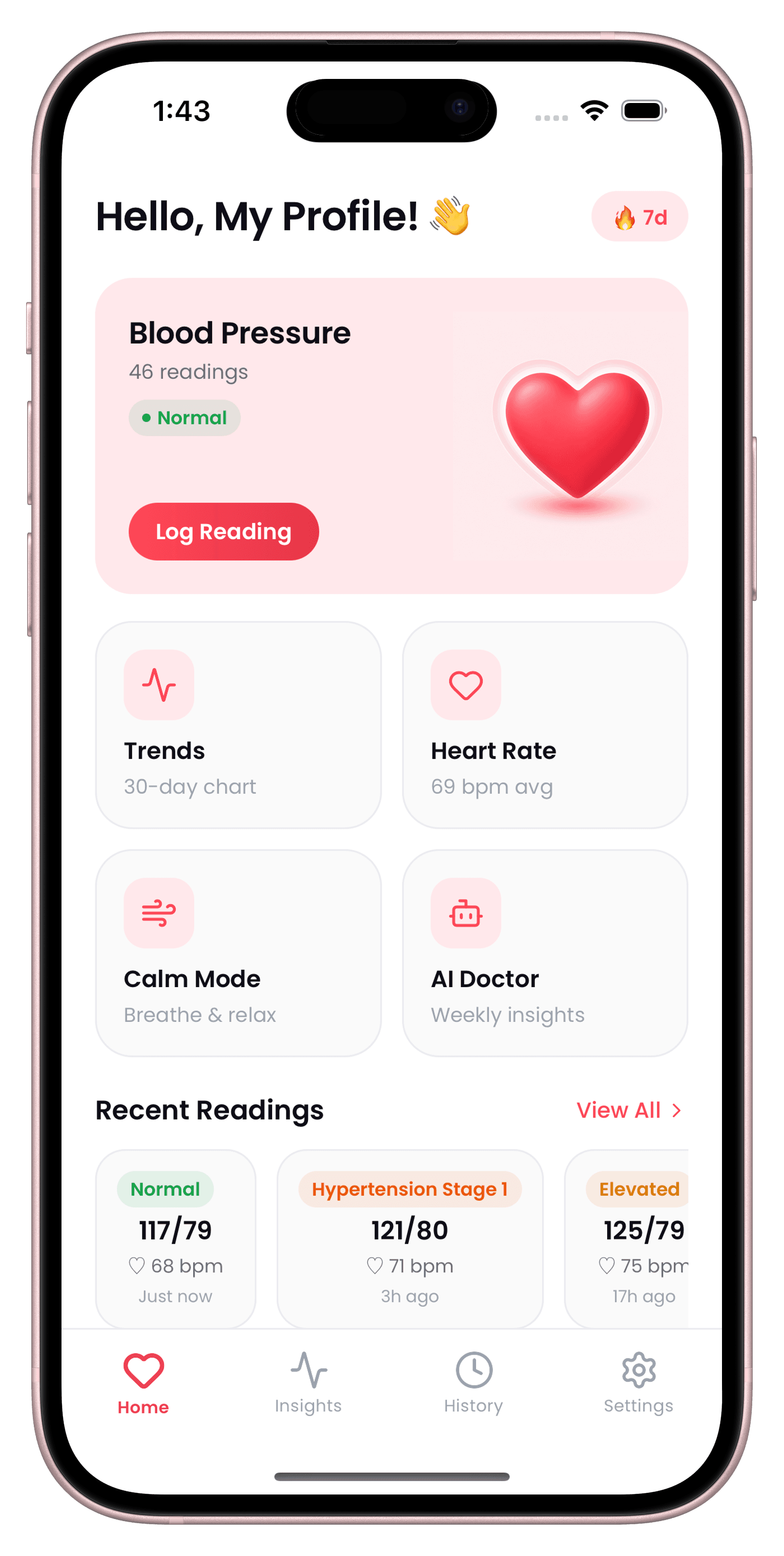
Waiting isn't always possible, and a reading taken after coffee still has value if you know it was. In the CardiLog app you can tag a reading with Caffeine, After Exercise, After Meal, Alcohol or Stressed, so when you look back, or share the PDF report with your doctor, an unusual number has its explanation next to it.
Sources
- Muntner P et al. Measurement of Blood Pressure in Humans: AHA Scientific Statement. Hypertension 2019
- CDC: Measuring Your Blood Pressure
- McEvoy JW et al. 2024 ESC Guidelines for the management of elevated blood pressure and hypertension. Eur Heart J 2024 (section 5.2)
- Mesas AE et al. The effect of coffee on blood pressure and cardiovascular disease in hypertensive individuals. Am J Clin Nutr 2011
- Pescatello LS et al. ACSM position stand: Exercise and hypertension. Med Sci Sports Exerc 2004
- Cleveland Clinic: Postprandial hypotension
- Pickering TG. The effects of smoking and nicotine replacement therapy on blood pressure. J Clin Hypertens 2001
- Tasnim S et al. Effect of alcohol on blood pressure. Cochrane Database Syst Rev 2020
- Million Hearts (HHS): 7 simple tips to get an accurate blood pressure reading
This guide is general information, not medical advice. CardiLog is not a medical device. Talk to your doctor about your own readings.