

Short answer
Buy an upper-arm monitor that appears on a validated device list (STRIDE BP, or validatebp.org in the US) with a cuff that fits your arm. Good options on STRIDE BP's home list include the Omron Evolv, Omron M3 Comfort and M7 Intelli IT, Withings BPM Connect, iHealth Track KN-550BT, Microlife BP B6 Connect, and Braun BUA4000. All seven list a validated cuff range of 22–42 cm.
Why upper-arm, and why validated
Guidelines prefer upper-arm cuffs for home readings. An AMA guide based on the American Heart Association's 2019 statement on blood pressure measurement says wrist cuffs aren't recommended unless an upper-arm cuff can't be used, for example because of arm size, and that finger devices are less accurate than upper-arm ones. Our guide to wrist vs upper-arm monitors explains why.
Validation means the exact model has been tested against a reference method using an accepted international protocol. That isn't the same as being sold in a pharmacy. The US Validated Device Listing (validatebp.org, run with the AMA) requires both FDA clearance and validation test results, which tells you clearance alone isn't the bar.
STRIDE BP, which works with the International Society of Hypertension and the European Society of Hypertension, keeps a similar list. It labels some models 'equivalent': they weren't tested themselves, but its scientific board accepted evidence that they measure the same way as a validated model, with differences like Bluetooth or memory.
How we picked
We pulled STRIDE BP's list of monitors and kept upper-arm models marked available, approved for home use, and from widely sold brands. We opened each model's entry to confirm its cuff range, features, and validation study. We weren't able to load validatebp.org while writing, so if you're in the US, check your exact model number there too.
Model names differ by country. The code in brackets (like HEM-7155-E) is what the list is based on, so match it to the box or manual before you buy. We haven't included prices because they change too often to keep accurate.
Get the cuff size right
A cuff that doesn't fit skews the reading. In the Cuff(SZ) trial (JAMA Internal Medicine, 2023), people who needed a large cuff read 4.8 mmHg higher systolic on average with a regular cuff, and people who needed a small cuff read 3.6 mmHg lower.
Measure around the middle of your upper arm, halfway between shoulder and elbow. The AMA's cuff guide gives these ranges:
- 22–26 cm (8.7–10.2 in): small adult cuff
- 27–34 cm (10.6–13.4 in): adult cuff
- 35–44 cm (13.8–17.3 in): large adult cuff
- 45–52 cm (17.7–20.5 in): extra-large adult cuff
Each monitor below lists a validated cuff of 22–42 cm, which covers most adults. If your arm is near either end, or over 42 cm, check the cuff range on the list before buying. Our cuff size chart shows how to measure your arm.
1. Omron M3 Comfort (HEM-7155-E)
Best for: a straightforward monitor with no app or Bluetooth to set up.
- Pro: listed for adults, people with diabetes, and pregnancy (including preeclampsia), as equivalent to the validated Omron BP760N.
- Pro: stores multiple readings, detects body movement, and has a cuff wrapping sensor that checks the fit.
- Con: no smartphone connection listed, so you log readings yourself.
2. Omron M7 Intelli IT (HEM-7361T-EBK)
Best for: people who want Bluetooth and an atrial fibrillation check from the same cuff.
- Pro: STRIDE BP lists atrial fibrillation detection, automatic repeat measurements, memory, body movement detection, a cuff wrapping sensor, and smartphone Bluetooth.
- Pro: listed for adults, people with diabetes, and pregnancy, as equivalent to the validated Omron BP760N.
- Con: an AFib flag on a cuff isn't a diagnosis. Your doctor would confirm it with an ECG.
3. Omron Evolv (HEM-7600T-E)
Best for: people who want Bluetooth and automatic repeat readings.
- Pro: its own validation studies for adults and for pregnancy and preeclampsia.
- Pro: automatic duplicate measurements, memory, and smartphone Bluetooth.
- Con: the validated cuff covers 22–42 cm, so very large arms are out.
4. Withings BPM Connect
Best for: households already using Withings gear, or anyone who wants Wi-Fi sync.
- Pro: validated for adults and for pregnancy and preeclampsia under the current ISO 81060-2:2018 standard.
- Pro: Wi-Fi and Bluetooth, memory, and a wide-range cuff.
- Con: its app features are built around the Withings ecosystem.
5. iHealth Track (KN-550BT)
Best for: an adult who wants a validated cuff from iHealth.
- Pro: validation study for adults under the ISO 81060-2:2018 standard, published in 2023.
- Pro: validated cuff range of 22–42 cm.
- Con: the KN-550BT entry lists no extra features, so check the box for memory and Bluetooth on the version you buy.
6. Microlife BP B6 Connect (BP3KV1-5X)
Best for: buyers in the UK and Europe, where Microlife is widely sold.
- Pro: validated for adults under ISO 81060-2:2018, with a study published in 2025.
- Pro: memory, smartphone Bluetooth, and a wide-range 22–42 cm cuff.
- Con: listed for adults only, with no special populations.
7. Braun BUA4000
Best for: the simplest validated option with a wide-range cuff.
- Pro: validated for adults under ISO 81060-2:2018, published in 2023.
- Pro: wide-range 22–42 cm cuff.
- Con: the list doesn't show memory or any phone connection, so plan to log each reading.
Logging readings from any of these monitors
A monitor shows you a number. Your doctor needs a pattern. The NHS suggests taking two readings a minute apart, in the morning and in the evening, for as many days as your doctor asks.
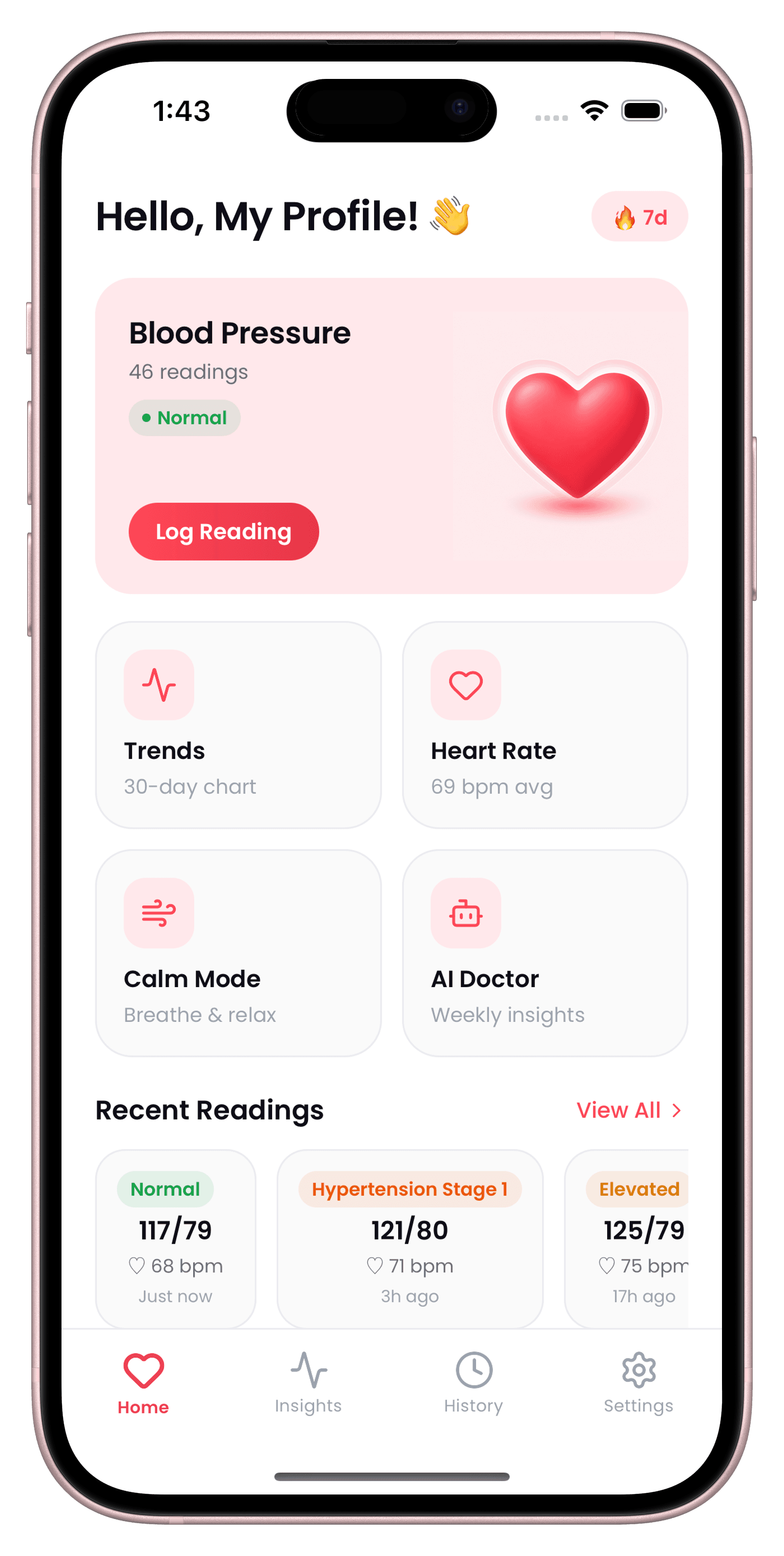
CardiLog works with any monitor on this list, Bluetooth or not, because it doesn't pair with cuffs at all. Disclosure: we make CardiLog. You type the reading in or point your camera at the display and the numbers fill in. Each reading gets an AHA stage, and the app checks for morning surges and sustained rises. When it's time for an appointment, export a PDF report. CardiLog needs a subscription for full use. If your cuff has Bluetooth, its maker's free app is also an option, and our iPhone app roundup compares them.
Before your first reading, read our guide to measuring accurately at home. Rest, posture, and a bare arm matter as much as the monitor.
Sources
- STRIDE BP: Validated blood pressure monitors
- AMA: Self-measured blood pressure cuff selection (from Muntner et al., Hypertension 2019)
- AAFP POEM: Cuff size and blood pressure accuracy (Cuff(SZ) trial)
- AMA: Why doctors and patients can count on these BP devices
- NHS: Blood pressure test
This guide is general information, not medical advice. CardiLog is not a medical device. Talk to your doctor about your own readings.