

Short answer
Upper-arm monitors are the standard for home use. The American Heart Association recommends an automatic upper-arm cuff and says wrist monitors give less reliable readings, and STRIDE BP lists wrist devices as generally not recommended. A wrist monitor is a fallback for when an upper-arm cuff can't be used, for example if no cuff fits your arm. If you use one, choose a validated model and keep your wrist at heart level, because readings come out too high below heart level and too low above it.
What the guidelines say
- American Heart Association (patient guidance): use an automatic upper-arm cuff monitor. Wrist and finger monitors aren't recommended because they give less reliable readings.
- AHA 2019 scientific statement on measurement: strong reservations about wrist devices unless measuring at the upper arm isn't feasible, and clinicians should recommend only validated upper-arm cuff devices.
- 2024 ESC guideline: home monitoring is done with an upper-arm cuff device. If no upper-arm cuff fits because of significant obesity, the lower arm or wrist can be considered.
- STRIDE BP: wrist devices are generally not recommended, because of lower accuracy and how hard they are to use correctly.
So the sources agree: start with an upper-arm monitor, and treat a wrist monitor as the option when that doesn't work for you.
Why wrist readings are harder to get right
The AHA's 2019 statement names two problems. The sensor has to sit over the radial artery, and bending the wrist makes that harder. And the wrist has to be at heart level: blood pressure measured below the heart reads too high, and above it reads too low.
On an arm resting on a table, an upper-arm cuff sits roughly at heart level. A wrist has to be deliberately raised and held there. An older AHA statement (Pickering, 2005) put the error from position at about 2 mmHg per inch above or below heart level, and possibly 10 mmHg or more. A later study (Adiyaman, 2006) measured a smaller effect, about 0.5 mmHg per centimetre. The size varies; the direction doesn't.
Fewer wrist monitors are validated
The AHA's 2019 statement notes that wrist devices have only been able to pass validation studies in the past decade. STRIDE BP's home list, as generated on 22 October 2026, counted 55 validated wrist devices on the market, against 350 upper-arm devices.
Buying online makes the gap wider. A 2020 study of monitors sold online in Australia (Picone, Hypertension) found 18.3% of upper-arm devices and 8.0% of wrist-cuff devices were validated, and none of the wrist-band wearables.
When a wrist monitor makes sense
The main reason is arm size. If your upper arm is larger than an extra-large cuff covers, the AHA's 2019 statement says blood pressure may be measured at the wrist, and the ESC says the same where no cuff fits. Check first: our cuff size chart shows how to measure your arm, and an extra-large or cone-shaped cuff may solve it.
If you have another medical reason you can't use a cuff on either upper arm, ask your doctor which device and arm to use.
How to use a wrist monitor
- Choose a validated model. STRIDE BP's home list includes wrist devices such as the Omron RS7 Intelli IT (HEM-6232T-E) and the Microlife BP W100.
- Sit as for any reading: back supported, feet flat, after at least 5 minutes of rest.
- Rest your elbow on a table and raise your wrist to heart level. Some wrist monitors only measure when held at the right height.
- Keep your wrist straight, not bent up or down, and stay still and quiet until it finishes.
Then take your wrist monitor to an appointment and compare it with the clinic's device, as described in our guide to checking your monitor's accuracy. The rest of the routine is the same as for an upper-arm cuff, covered in our guide to accurate home readings.
Logging wrist readings
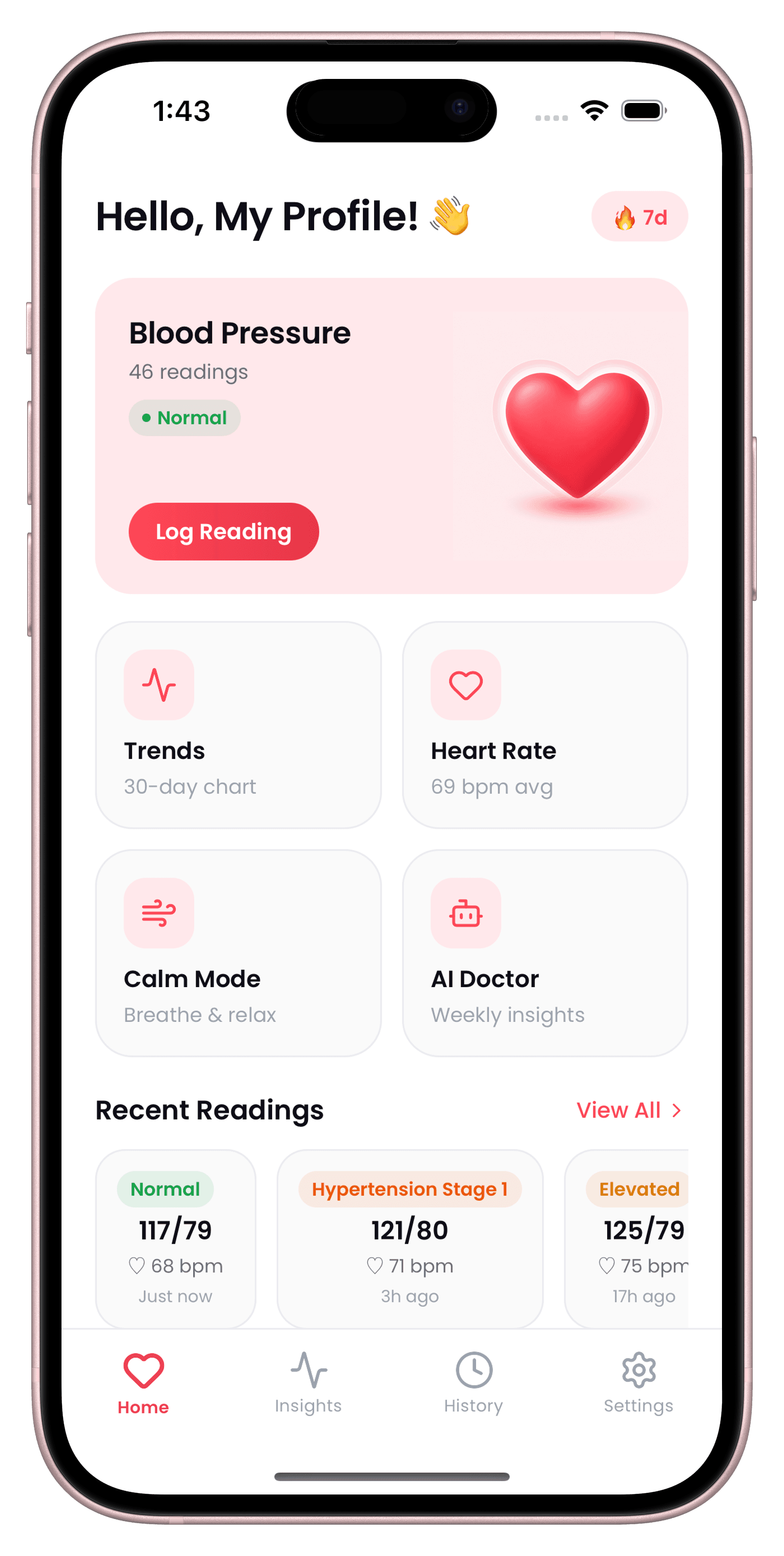
Stick to one monitor where you can, so changes in your log reflect you rather than a switch of device. The CardiLog app works with wrist and upper-arm monitors alike, since you type a reading in or photo-scan the display, and you can add a note to say which monitor you used. Our guide to validated home blood pressure monitors covers choosing an upper-arm model.
Sources
- American Heart Association: Monitoring your blood pressure at home
- Muntner P et al. Measurement of Blood Pressure in Humans: AHA Scientific Statement. Hypertension 2019
- McEvoy JW et al. 2024 ESC Guidelines for the management of elevated blood pressure and hypertension. Eur Heart J 2024 (section 5.2)
- STRIDE BP: Validated blood pressure monitors for home use
- Pickering TG et al. Recommendations for blood pressure measurement in humans and experimental animals (AHA). Hypertension 2005
- Adiyaman A et al. The position of the arm during blood pressure measurement in sitting position. Blood Press Monit 2006
- Picone DS et al. Nonvalidated home blood pressure devices dominate the online marketplace in Australia. Hypertension 2020
This guide is general information, not medical advice. CardiLog is not a medical device. Talk to your doctor about your own readings.