

Short answer
Mean arterial pressure (MAP) is the average pressure in your arteries over one heartbeat. A common estimate is diastolic plus one-third of the gap between systolic and diastolic, so 120/80 gives about 93 mmHg. Doctors usually treat 70–100 mmHg as normal, and a MAP below about 60–65 mmHg can mean organs aren't getting enough blood.
Mean arterial pressure (MAP) calculator
MAP = diastolic + (systolic − diastolic) ÷ 3
Enter a reading to see the result. It's worked out on this page and not saved.
The MAP formula, worked through
The standard bedside estimate is MAP = diastolic + ⅓ × (systolic − diastolic). You'll also see it written as (systolic + 2 × diastolic) ÷ 3. Both give the same answer.
- 120/80: 80 + 40 ÷ 3 ≈ 93 mmHg
- 140/90: 90 + 50 ÷ 3 ≈ 107 mmHg
- 100/60: 60 + 40 ÷ 3 ≈ 73 mmHg
- 160/70: 70 + 90 ÷ 3 = 100 mmHg
It's an estimate. In hospital, MAP can be measured continuously through a line in an artery, and the monitor calculates it from the actual pressure wave. Some automatic home monitors also display a MAP figure, often in brackets next to the main reading. Check your monitor's manual to be sure what an extra number means.
Why MAP leans toward the diastolic number
A heartbeat has two phases. In systole the heart contracts and pushes blood out. In diastole it relaxes and refills. At a normal resting heart rate, diastole lasts roughly twice as long as systole.
Since your arteries spend more time at the lower pressure, a plain average of the two numbers would overstate the true average. That's why the formula gives diastolic about two-thirds of the weight. At fast heart rates, diastole gets shorter, so the simple formula becomes less exact.
What's a normal MAP?
Most sources put a normal resting MAP at around 70–100 mmHg. Some give a slightly wider range, so don't read too much into a number a few points outside it.
- Under about 60 mmHg: there may not be enough pressure to push blood to the brain, kidneys and heart.
- 70–100 mmHg: the range most sources call normal.
- Over 100 mmHg: typically reflects high blood pressure, and you'd see it in your systolic and diastolic numbers too.
A MAP of 93 from a 120/80 reading sits comfortably in the middle. A Stage 2 reading like 150/95 gives about 113, which is above the range.
Where doctors actually use MAP
MAP matters most in hospitals, especially intensive care and during surgery, where a team needs one number to track whether organs are getting enough blood flow. For example, the 2021 Surviving Sepsis Campaign guidelines recommend an initial MAP target of 65 mmHg for adults with septic shock who need medicines to support their blood pressure.
It's much less common at a routine checkup. Diagnosis and staging of high blood pressure are based on systolic and diastolic numbers directly. The AHA's stages (Stage 1 starts at 130/80) and NICE's home threshold of 135/85 both use the two numbers, not MAP.
Why MAP alone can mislead you at home
Two readings can share almost the same MAP and still tell different stories. A 120/80 reading and a 130/75 reading both work out to about 93 mmHg. The second has a higher systolic and a wider pulse pressure, which is the kind of detail that matters as you get older.
MAP also gets mixed up with your average blood pressure. MAP is the average within one heartbeat. Your weekly average is the average of many readings, and it's still written as two numbers, like 128/82. When a doctor asks for your home average, they mean the second one.
So it's best to treat MAP as one extra number alongside your systolic, diastolic and pulse, not as a replacement. If you're still getting to grips with what each number means, start with our guide to understanding blood pressure readings.
When a MAP number needs attention
- A low reading with dizziness, fainting, confusion or cold, clammy skin needs prompt medical help.
- Home readings that are consistently above 100 mmHg generally mean your blood pressure is high overall. Book a visit with your doctor.
- If a reading is 180/120 or higher and you have symptoms like chest pain, shortness of breath, weakness or trouble speaking, call emergency services.
A single unusual MAP with no symptoms is, in most cases, a reason to rest quietly and measure again, not to panic.
How CardiLog handles MAP
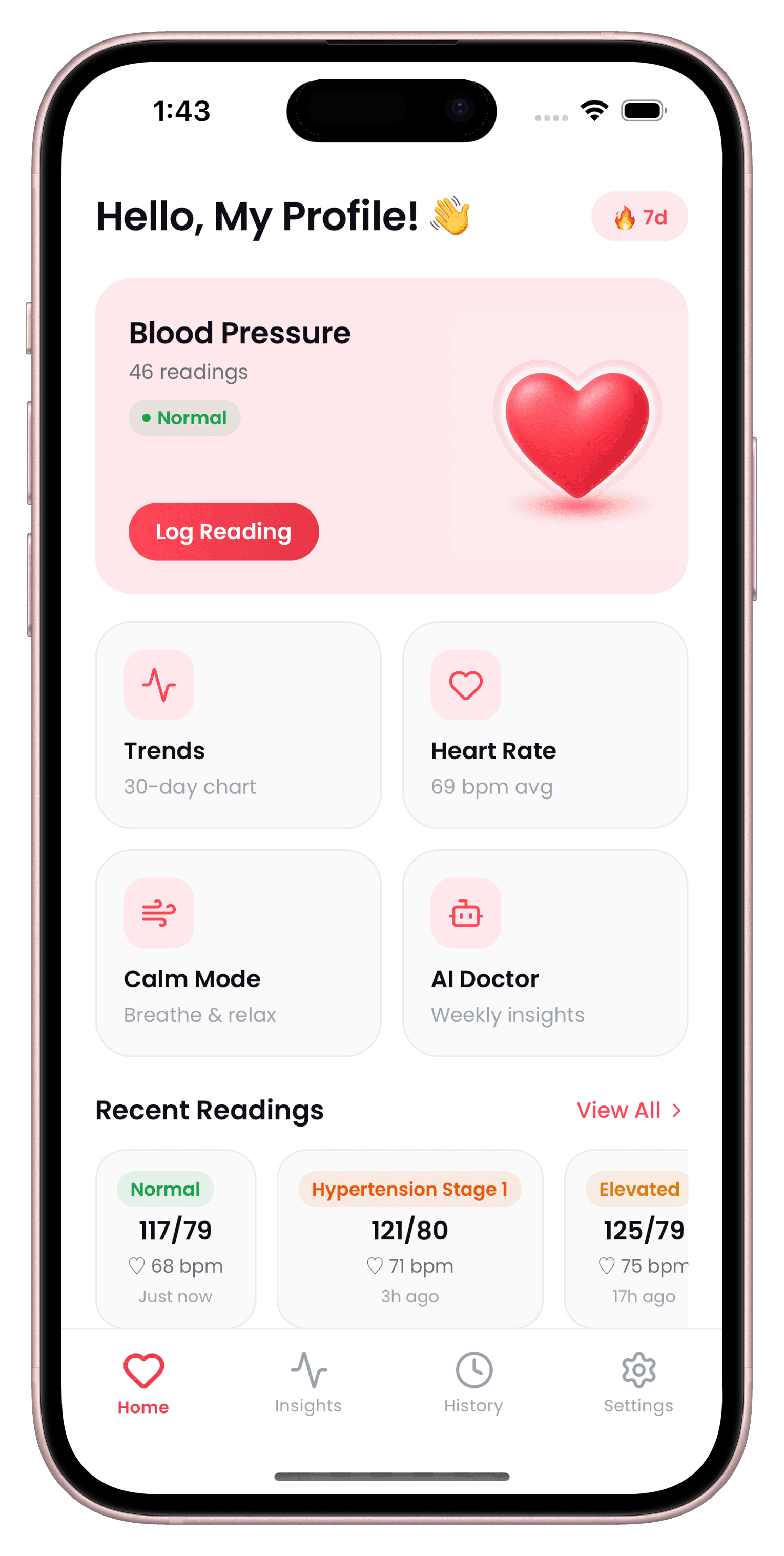
CardiLog calculates MAP automatically with the standard formula (diastolic + one-third of the difference), next to pulse pressure. You don't need to enter anything extra. Readings can be typed in, scanned from your monitor's screen with the camera, or imported from Apple Health. More on that in blood pressure logging.
MAP and pulse pressure both appear in the PDF report you can export, along with your readings, averages and stage. Readings are staged using the AHA 2017 categories based on systolic and diastolic, not on MAP.
CardiLog isn't a medical device and can't tell you whether your MAP is right for your situation. It's shown so you or your doctor can find the number when you want it.
Sources
- Healthline: Mean Arterial Pressure
- emDocs: Surviving Sepsis Campaign 2021 Updates
- NICE NG136: Hypertension in adults, recommendations
This guide is general information, not medical advice. CardiLog is not a medical device. Talk to your doctor about your own readings.